
COULD THIS BE A SIMPLE MISUNDERSTANDING?

NUGGETS OF STORIES . . . FEBRUARY 2026
In my January ’26 newsletter, I mention that I want to spend this year focusing on the “nuggets” or the places where stories originate for me. But I must confess I find it difficult at times, with all the turmoil going on across our nation, to be able to focus on only one ‘nugget’ at a time. My mind has been swirling lately with the massive crescendo of events in Minneapolis, where my great-niece found herself scrambling to find a safe haven for her husband and children. Upon taking her preschooler to school, she found ICE agents prowling around the perimeter of the facility. At home, protesters and ICE filled the streets near her house. Fortunately, she was able to find refuge with her mother, my niece, but not without the entire family feeling rocked with fear and trepidation regarding the situation at large. This is not normal; and for them to proceed back into their lives does not ‘feel normal.’ My heart aches for them.
So, I ask, how have we come to this? How do these actions start? Isn’t democracy color-blind? As Governor Walz indicated, he hopes these protests are not a precursor to a civil war. A civil war? How can that be? The mention of Fort Sumter loomed from the past. Again, how did we get here? How do protests, then wars get started? Is there any rhyme or reason to it? Could this be a simple misunderstanding?
As I’ve written before, I have been digging through old files, folders, newspapers, and death notices of my ancestors with the hope of a better understanding of who I am. (Honestly, I’ve been hoping to find a thimbleful of Irish among them, as I lay claim to their story-telling ability.)
In one yellowed and very tattered old newspaper, the Herndon Nonpareil (Herndon, Ks.) dated August 13, 1914, I ran across the death notice of my Great-Great Grandfather Levi Slocum. It was noted that he was “one of the old settlers in town and was an aged and respected citizen.” I checked and he was born in 1829 so, at 1914, he was 85. (At age 80 years of age myself, I’m suddenly feeling so much more ancient than I realized.)
But, curious to understand what was happening in the community at the time of his death, I was surprised to find that this small weekly newspaper was a paper which contained, not only a generous rundown on the news locally, but held a full and lengthy accounting of the whole world. Mind you, this was a town of no more than 100 people perched boldly out on that windswept and barren wasteland of the western plains of Kansas!
Again, the date of the paper was August 13, 1914. World War I had begun. In this one issue, I was surprised to find a list of all the countries which had just joined the war effort. Of course, this was following the assassination of Archduke Ferdinand of Serbia on June 28th with war being declared a month later on July 28th by Austria-Hungary and Germany. But it was within the week of my great-great-grandfather’s death, that Russia, France, Great Britain, and Belgium joined up with Serbia for the fight. The articles in the newspaper were entitled: ‘Nicolas Issues Manifesto’ as Emperor Nicolas of Russia decides his country’s fate; ‘Germans Advancing on France’ ‘Battle Between Aircraft’ (the first chapter on air warfare); ‘Food Prices Leap Skyward.’
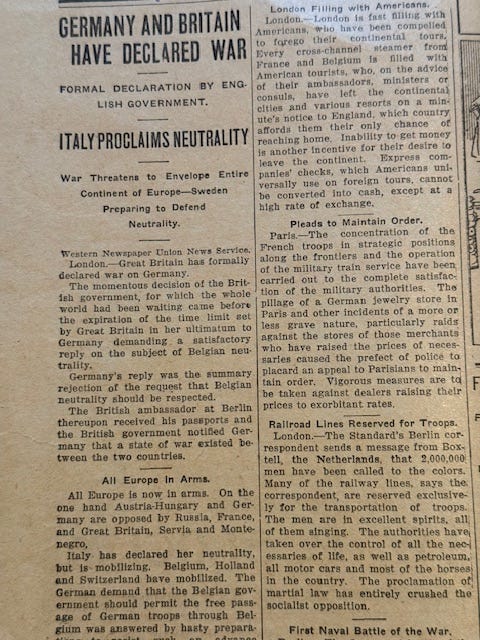
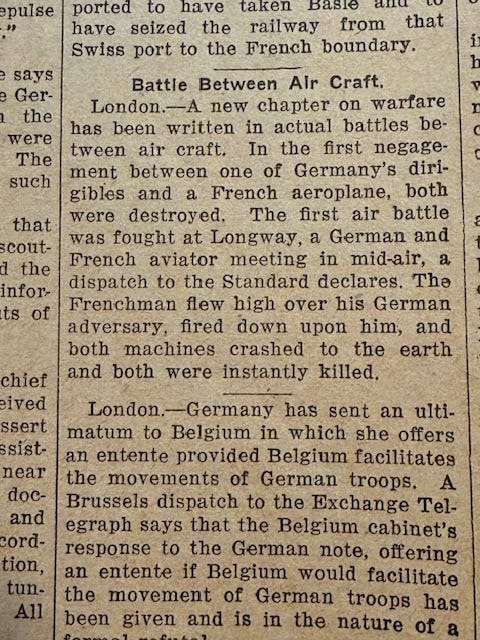
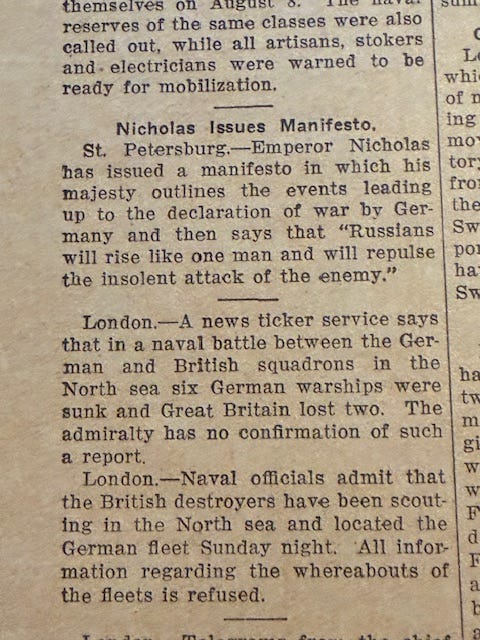
Within these tattered pages, I learned that of the four great powers of Europe: Austria-Hungary, Russia, France, and Germany, neither France nor Germany had declared war on the other. The explanation? “It would appear to be that Germany and France each sought to throw upon the other the responsibility of the war.” (I’ll reserve my comments.)
But, I wondered, how did the war get started in the first place? Had there been protests? World wars had not been declared before, so how and why now? The paper went on to explain that when this skirmish began, there was a great deal of confusion as to what was happening, who was taking responsibility (and for what) and how this ‘blame thing’ began in the first place. The question of ‘why’ it began, hung in the air. Did they mean to push the envelope this far?
Ah, but in an additional article . . .( can you believe this came from the same newspaper?) . . . . I found one explanation of the ‘how and why’ this war began. Entitled Traces War to a Clash of Tongues. Professor Dorsey of Chicago Field Museum Finds Austria’s Attitude a Sequel to Pan-German vs. Pan-Slav Contest. He says the war was“Not Economic, but Psychologic.” Nations are Now as Ever in the Past, Divided by Language. Source of trouble, it seems, is that political boundaries are not with linguistic groups.”
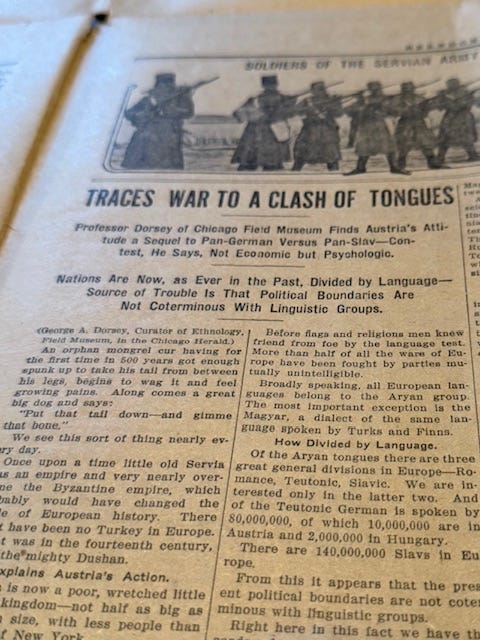
The thread of this article speaks to the fact that ‘before there were country flags and religions, people knew each other only by their languages. The majority of Europe is/was composed of Aryan tongues, except for Finland and the Turks. “Within the Aryan languages you find both Teutonic and Slavic tongues. The mere mention of these two different tongues reveals the inability to understand each other definitively.” In other words, there, perhaps, was a tragic misunderstanding when the Archduke was killed, and the world war was predicated on not fully understanding one another’s languages. (My god! I wonder how often this may have taken place?)
What I realized was that the importance of having fully understood what a story means and, in the context it is stated or written, demands a good translation. It is also the purpose of a good press. As we know today, what we understand about the world around us and what we gather from the few tidbits of information can be gleaned from today’s newspapers, as was the case in a 1914 newspaper.
So, what did I take away from this scan from the past? That newspaper’s stories, along with the internet, plus, the very nuggets of our own stories, help guide and inform us who we are, where we come from, what we believe, what we value and how we behave. Whether it is the heart-wrenching story of my family in Minneapolis, or the stories gleaned from a newspaper from the past, we come to terms more fully with who we are as human beings in this . . . yes, volatile world we live in.
To understand further what war was like in France, my novel, A Cup of Redemption, spells out a French woman’s story of survival from WWI through WWII and beyond in a brave attempt to keep her family safe and intact.

What snippets of stories do you have stirring in your mind? What do you write about when you take time to air your feelings? Let me know how you are, as we are here together.
Great research, Carole. What an interesting article. And how tragic that an estimated 50 to 70 million people had to die for a cause nobody quite understood. Frightening times we now find ourselves in with the doomsday clock striking 85 seconds to midnight.
Really important and disturbing observations. We are indeed if a frightening world I never thought I'd see in this country.